

Adenium is a genous of flowering plants, belonging to the family of Apocynaceae. It is a native of Arabian peninsula and Africa.
The special feature of this family of succulents is that they develop a caudex or swollen stem, at the base. The function of the caudex is to store moisture for times of droght.
As bonsai, they grow very well. One interesting aspect of this desert rose plant is that even in their natural habitat, they resemble, a bonsai.
To train them as bonsai, choose a soil mix, that is gritty and porous.. Clayey soil is an absolute no for them.
When you plant your Adenium, see that the caudex is above the soil.. They prefer direct sunlight as they are desert plants.. Five to six hours every day is a must.
Watering can be done every day, in moderate quantity. Over watering can kill the plant... They can withstand rainy season for a couple of months.
Fertilizer can be 19.19.19..That is NPK.. You can dissolve it in water and apply a very dilute solution every month. . Diluted panchakavya is good too. As solid Fertilizer, Farmyard manure is good.. Apply it once in six months..
Pruning the tips is essential to make it look dwarf.. It induces flowers too...
Fertilizer rich in potassium and phosphorus is good for flowering.
It is basically free of pests.. Some times caterpillars can be spotted.. Aphids are also seen. Spraying with neem oil is a good remedy..
If you spot decay on the roots or stems, that portion should be cut off and apply any fungicide...
To grow adeniums as bonsai is comparatively easy and you can expect good results in a short period of time...
Vijaya Chamundeswari
Style is something very individual. Some men drool over seeing well endowed women while there may be others who can’t take their eyes off a slender size zero. What seems to be nice and bold and clear might please some while a little off beat and abstract appease others. It is the ‘literate’ who are artistically inclined, that usually have an eye for this kind of an art, which is why the name ‘Literati’. A simpleton might not want to twist his brains to understand the abstract beauty that is not very obvious to the mind. Going off the usual track too has to have a balance or else it would be a confused mess. Nature takes care of this beautifully in giving a touch of class to the survival journey of a few trees/plants. We can find a few of these by the sea side which take the battering of the wind and manage to bend twice over to just stay alive. Some trees that are caught up between other trees or buildings too, take a Bunjin form by going or rather growing in search of light. Imitating this aspect of Nature is what we do in Bunjin as the Japanese call it.
While picking a plant for Bunjin, as far as possible try to see if it already has a long slender trunk which gives in to bends and twists. Some might already have it in them naturally and all we have to do then is remove the lower branches and keep the apex alone. Using our imagination we can wire it with a design we would have already construed in our minds. If we are not able to get an idea on our own there are enough and more available in the net. While creating the bends we have to keep in mind the centre of gravity. This gives better stability for the plant and a balance in appearance too.

As a rule (up to you to follow or not) we have branches only in the top 1/3 of the plant or may be further beyond. Let’s keep it tall in stature which adds up to its elegance. Some of the words akin to this style are - ‘elegant, simple, clean, tall, slender and flowing’. We try to achieve all of this keeping in mind ‘symmetry in asymmetry’. Confused! Good. Only when we are confused we get innovative and our mind wriggles out creatively. Rules block our creative flow. So just let the main trunk grow and grow and grow until you feel enough is enough and start chopping off the lower branches to about 2/3. Style it the way your mind reads it. It can have curves or angles. All the basic bonsai styles like formal upright, informal upright, cascade, semi cascade etc; work well. Taking it a notch further would be a forest or a twin trunk too. Thick trunk or dense foliage doesn’t matter here. Less foliage highlights the trunk line which is the main focus.

Maintenance is the same as any Bonsai. The tall beauty needs to sit pretty in a cozy little pot which preferably is round or oval. Even a shallow plate with an accent of rock or a figurine would add up to its looks. The plant might need to be wired firmly to the pot base usually off centre. Since the small pot holds little soil we might have to fertilize and water with more frequency, again this goes with the plant species. Casuarina, bougainvillea, caecalpinia, tamarind are a few of the indigenous varieties that suit this style. No rules means more responsibility. So let’s get responsibly unruly in creating this style like a true literate of Bonsai.
Kiluvai or Commiphora Caudata or Hill mango (Pachai kiluvai in Tamil) is mainly used for cheap live fencing for agricultural land.
 |
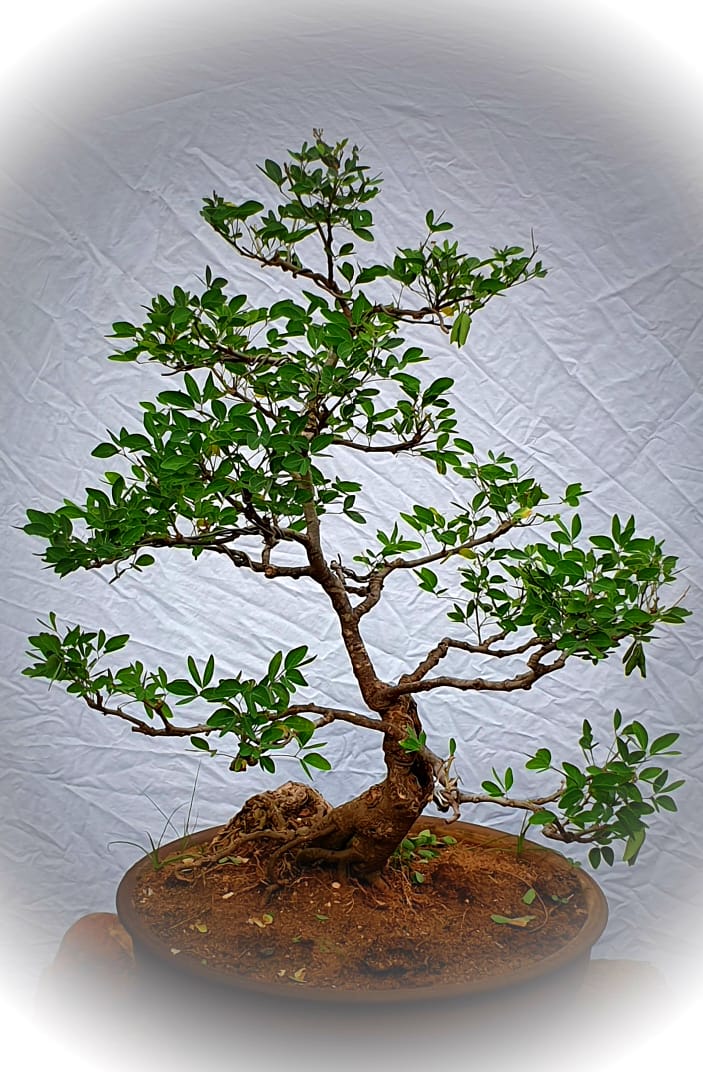
| Kiluvai , informal upright style. |
 |
 |
| Mame Literati style. |
Name in Tamizh : Kodukapulli
Botanical name: Pithocellobium Dulce
Other commmon names:
Manila tamarind, Madras thorn,
Camachile and Guamúchil. It also has various other local names as it is found in most parts of the world.
The plant, is native to Mexico, CentralAmerica and north southern America.
It belongs to the pea family and is classified as Fabaceae.
Left to nature it easily reaches a height of 10- 15 m. On younger trees the bark is smooth and pale whitish grey. On older trees, the bark turns rougher and fissured with ribs, which looks interesting on bonsai.
The flowers are greenish white and fragrant. The trees start to fruit only after 4 to 8 yrs of age,during the dry season, with pods appearing 2 to 3 weeks after flowering.
The fruits are edible and sweet
and the pods are shaped into spirals which is the origin of the name pithocellobium. Pitho meaning monkey and cellobium meaning earrings. Dulce means sweet. The tree is named after the shape of the fruit.
The leaves are bipinate, it has very sharp thorns. There are some varieties that are thornless and they also release a sap which is irritating to the skin.
All parts of the tree is useful as the fruit is consumed all over the world and the leaves and branches are used as foliage and fodder for the animals. It also has medicinal value.
There is another variety with a variegated form of leaf with colours of pink, white and green but in my experience, this doesn’t fruit.
Also there is a small leaved variety.
Pithocellobium lends itself to most bonsai shapes and can be converted very easily into formals , informals, cascades or literati.
Most pods have around 10 shiny black seeds which germinate very easily, the plant can also can be propagated very easily by cutting and air layering.
A very easy plant to grow, it grows in even drought filled conditions or in the swamps. It is also easy to make this plant into a bonsai in a short period of time.
 |
 |
| by Email | by RSS |


